Illuminating Human Movement: A Deep Dive into What Night-Time Lights Tell Us About U.S. Migration
Migration is a fundamental, defining characteristic of the human story. By its very definition, migration is spatial—involving a permanent change in residence where a person transfers their full cycle of daily activities from one place to another. As one demographer aptly put it, you cannot be a migrant unless you actually "leave your room".
Throughout history, humans have packed up their lives for a multitude of reasons. From the earliest human migrations out of Africa 60,000 years ago to colonial settlers and modern urbanites, people move for security, better job markets, and perceived opportunities, or they are forced to relocate due to conflicts and natural disasters.
For decades, demographers and economists have relied on traditional frameworks to explain these movements. Early instances date back to the late 19th century with E.G. Ravenstein's "Laws of Migration," which noted that migration increases with economic development. By the 20th century, researchers developed "gravity models," analogous to Newton's laws of physics, suggesting that the bigger and closer two cities are, the more migrants they will exchange. Later models introduced Lee's "push and pull" factors—where favorable job markets or good weather attract migrants (+), while poor conditions repel them (-).
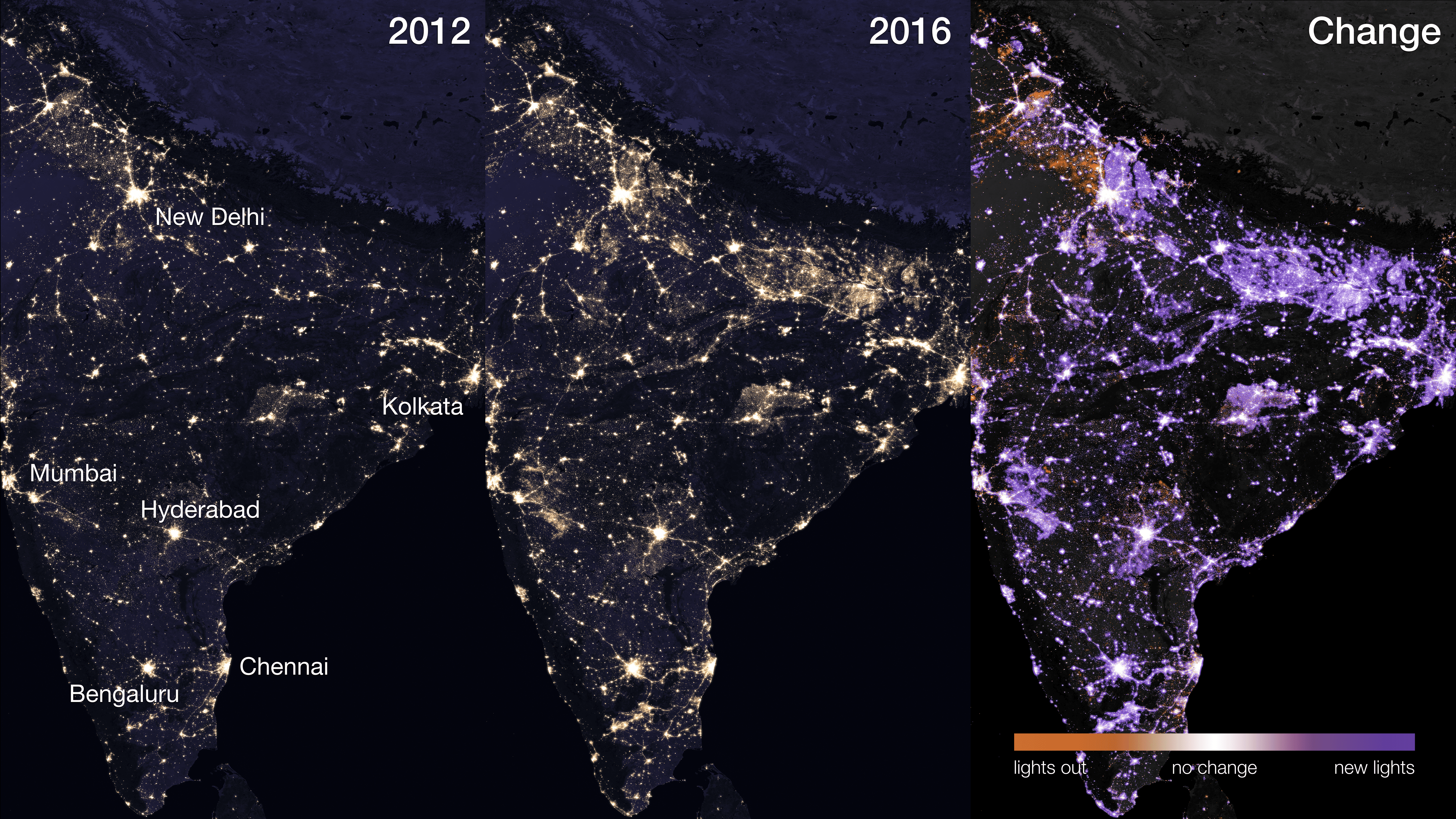
However, traditional demographic research heavily relies on censuses and surveys. While these are great for broad trends, they are time-consuming to work with and lack granular detail, often limited to census enumeration areas that average around 33 kilometers in size. To bridge this gap, modern researchers are turning to a fascinating, space-age proxy for human economic activity: satellite-derived night-time luminosity.
The "Light Matching" Hypothesis
The core idea behind using night-time lights (NTL) is simple but powerful: the assumption that economic activities requiring artificial lights at night are inherently related to economic output, urbanization rates, and population size.
Historically, researchers found that migrants often sought destinations with familiar environments. For example, in the 19th and 20th centuries, Scandinavian migrants to the U.S. actively preferred destinations with average temperatures and precipitation rates similar to their homelands—a concept known in recent literature as "Climate Matching".
Building on this, the "Light Matching" hypothesis asks: Do migrants prefer to move to areas that have similar night-time light levels as their hometowns?. By introducing this spatial metric, researchers can assess whether infrastructural and economic similarity plays a measurable role in where people decide to move.
The Data Trinity: Tracking Humans from Space and Tax Returns
To test the Light Matching hypothesis across the United States at a granular, county-to-county level between 2012 and 2021, a recent study cross-referenced three massive datasets:
1. NASA's Black Marble Suite (The NTL Data)
This satellite data captures high-quality night-time radiance from across the globe using the Visible Infrared Imaging Radiometer Suite (VIIRS) on the Suomi NPP satellite. To ensure the data reflects genuine human activity, the researchers used the VNP46A2 dataset, which corrects for moonlight, atmospheric conditions, and seasonal variations. The light intensity is measured precisely in $nW/cm^{2}/sr$ (watts per square centimeter steradian). To prevent heavily urbanized areas from skewing the data due to sensor saturation, the radiance values were capped at the 99th percentile.
2. IRS County-to-County Migration Data
While censuses happen every ten years, the IRS tracks relocations annually by monitoring address changes on tax returns. Capturing 95% to 98% of all taxpayers and their dependents, it is one of the most comprehensive datasets for understanding U.S. migration flows. It even allowed researchers to track massive shifts, like the migrations following Hurricane Katrina or the slowdowns during the 2008 Great Recession.
3. BEA County-Level GDP
To validate the night-time light data and control for standard economic pulls, experimental county-level GDP data from the Bureau of Economic Analysis (BEA) was used. This data is geographically allocated from state GDP using local wage and earning data, providing a rich picture of local economic activities.
Finally, the geographic distance between counties was calculated using the Haversine formula, which computes the shortest distance between two spherical coordinates based on the geometric centers (centroids) of each county.
The Methodology: Stepwise Gravity Models
Migration matrices are famously sparse (people don't migrate evenly between every single random county). To handle this, the study followed a stepwise approach using Ordinary Least Squares (OLS) specifications and advanced "gravity models," specifically the Poisson Pseudo-Maximum Likelihood (PPML) estimator.
The researchers looked at two primary variables:
Total Migration: The net flow of total migrants from the origin to the destination county.
Relative Migration: The number of migrants divided by the non-movers in the origin county, which adjusts for the county's population size.
By adding controls step-by-step—first just NTL similarity, then state fixed effects, then distance, and finally specific county socio-economic controls—they could isolate the true impact of the lights. They also utilized state-level clustering in variance-covariance estimators (VCE) to adjust for unobserved shared factors, like state-specific policies or historical trends.
The Surprising Verdict: Do Birds of a Feather Flock Together?
You might assume that people want to move to places that feel like home. However, the results revealed a complex and somewhat inverted picture of how light similarity impacts human movement.
Here is what the findings tell us:
Dissimilarity Drives Total Migration: In the baseline OLS model, the coefficient for NTL Similarity was strongly negative and statistically significant ($-3.946^{***}$). This indicates that as the absolute similarity between two counties increases, migration decreases.
Seeking New Opportunities: The data suggests that migrants actively choose destinations that are dissimilar to their origin. When looking for potential economic opportunities or different lifestyles, migrants have a higher probability of moving to places that do not match their origin's night-time luminosity.
The PPML Confirmation: The gravity models bolstered this finding. A 1-point deviation in $nW/cm^{2}/sr$ is correlated with approximately 3.9 people deviating in migration. A reduction of the sample average NTL from a county decreases migration by about 0.08%.
The Distance Caveat: An interesting interaction term emerged: as the distance between counties increases, the negative impact of NTL similarity on migration diminishes. This means when people move very far away, they are less influenced by the "light matching" dynamic and more by other factors.
Relative Migration is Muted: When adjusting for the proportion of people migrating (relative migration), the coefficient remained negative but the magnitude became incredibly small ($-0.001^{***}$ in OLS). This suggests that while raw migration flows heavily toward different NTL levels, the proportional decision to move is only slightly affected.
"This dichotomy highlights the complexity of migration decisions, which are influenced both by the attractiveness of different opportunities and the comfort of familiar environments."
Limitations and Blindspots
While tracking economic migration from space sounds like a foolproof science, the methodology still faces certain limitations that future research must address:
Data Exclusions: IRS migration data systematically excludes populations that do not file taxes, such as low-income individuals, certain students, and undocumented migrants. Additionally, county pairs with fewer than 10 tax returns are hidden for privacy.
Missing Human Variables: NTL is a fantastic proxy for urban infrastructure, but it cannot capture the nuances of the local job market, the housing market, or established social networks—all of which heavily pull migrants.
Multicollinearity Issues: The study found a highly inflated Variance Inflation Factor (VIF score of 22.07) for the GDP coefficient. This suggests high multicollinearity between NTL and GDP; essentially, they are measuring such similar economic realities that it is difficult for statistical models to untangle them cleanly.
Centroid Flaws: Calculating distance based on a county's geometric center (centroid) may not accurately represent where the population actually lives, especially in very large or irregularly shaped counties. Furthermore, straight-line distances don't account for actual road networks.
The Road Ahead
In a world where human movement is increasingly influenced by shifting economic landscapes, global pandemics, and climate change, understanding the mechanics of migration is deeply important.
Despite its statistical complexities, using satellite night-time luminosity offers a novel, quantifiable lens through which to view human dynamics. As this method evolves, future studies could combine "Light Matching" with cultural similarities, climate data, and the impacts of external shocks to offer urban planners and policymakers a powerful, real-time compass for predicting the future of our cities.